
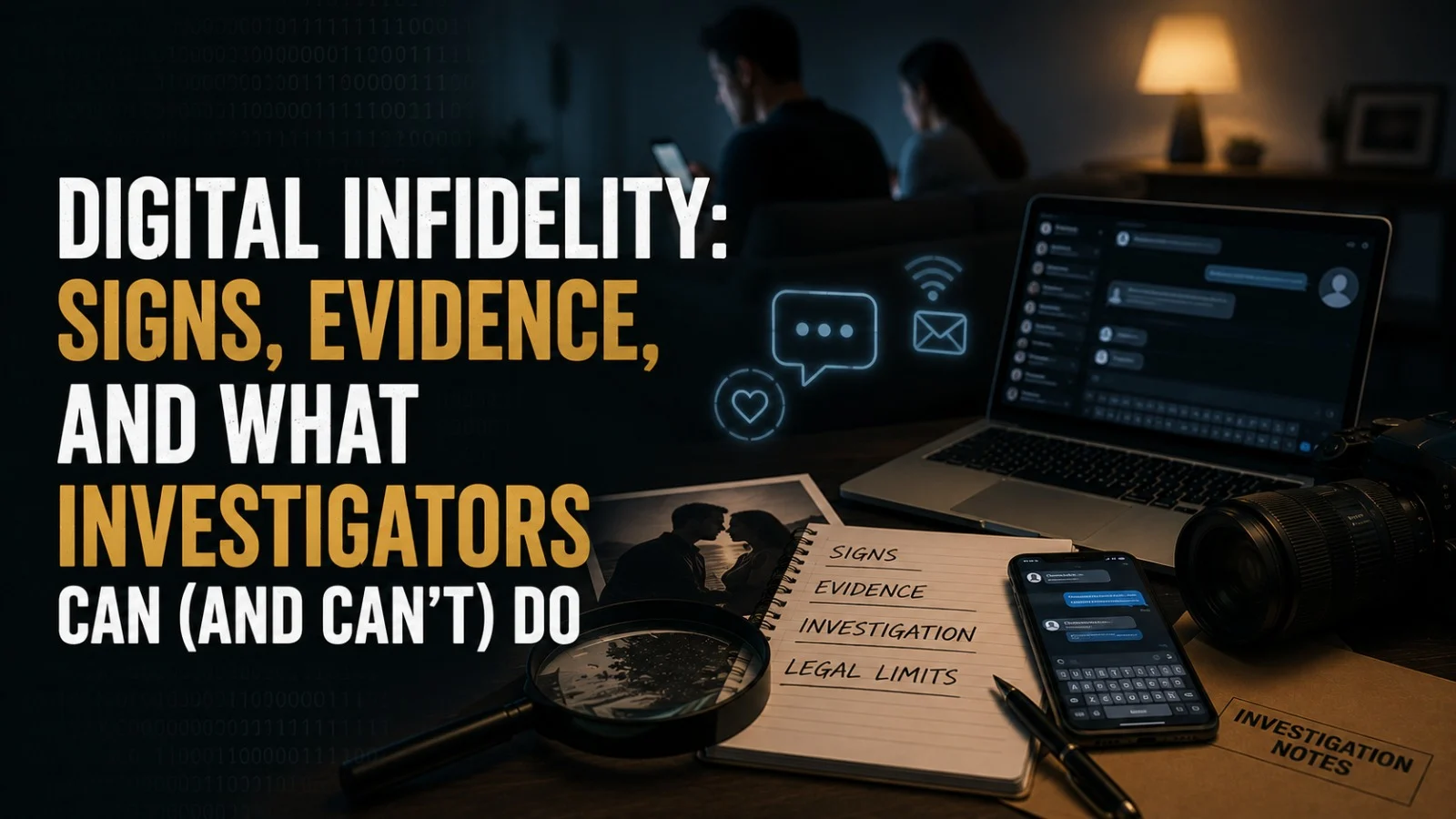
Digital Infidelity: Signs, Evidence, and What Investigators Can (and Can’t) Do
Infidelity used to leave physical traces — a receipt, a lipstick mark, a suspicious phone call. Today, most of it happens somewhere a spouse never sees: a disappearing-message app, a second social media profile, a dating app tucked into a folder on the second home screen. “Digital infidelity” covers all of it — and investigating it well means understanding both what’s genuinely detectable and where the law draws a hard line.
What Counts as Digital Infidelity Today
The behaviours clients most often want investigated fall into a few recurring patterns:
- Secret messaging apps used specifically because they auto-delete or hide notifications
- Active dating app profiles maintained during a marriage or committed relationship
- A second, undisclosed phone or SIM used exclusively for one relationship
- Financial trails — UPI payments, gift purchases, or hotel bookings that don’t match the story given at home
- Cloud-synced photo backups that surface content never shared on a primary device
Common Signs Worth Noting (With a Caution)
Behavioural changes that often prompt someone to investigate include sudden secrecy about a phone (face-down, always carried into another room), password changes without explanation, unexplained absences that don’t match a stated schedule, and a noticeable shift in emotional distance. It’s worth being honest, though: none of these signs are proof on their own. People change phone habits for all kinds of reasons, and jumping to conclusions from behavioural signs alone — without any actual verification — is exactly how false accusations and unnecessary relationship damage happen. Signs are a reason to seek proper verification, not a substitute for it.
What a Legitimate Investigator Can Actually Do
A professional investigation in this space works within the same legal boundaries that apply to any private investigation in India:
- Open-source research on public-facing profiles — dating apps, social media, and any publicly viewable digital footprint
- Surveillance in public settings to corroborate or rule out a suspected pattern of meetings
- Financial trail analysis using records the client has lawful access to (a joint account statement, for instance)
- Device analysis with proper authorization — for example, examining a device the client legitimately owns or has consented access to, rather than one belonging solely to the other party
- Documentation and reporting built to the same evidentiary standard needed if the matter proceeds to a divorce or maintenance case
What Investigators Legally Cannot Do
This is where digital infidelity cases carry more legal risk than almost any other category of investigation, because the “obvious” shortcut is also the most clearly illegal one:
- Hacking into a spouse’s email, social media, or messaging accounts — a criminal offence under the Information Technology Act, regardless of who the account holder is married to
- Installing spyware on someone else’s phone without their knowledge — this is unauthorised access under the IT Act and carries real criminal exposure for whoever does it, and for whoever commissioned it
- Phone tapping or intercepting calls without consent — illegal under the Indian Telegraph Act
- Accessing a spouse’s cloud backups (iCloud, Google Photos, etc.) without their account credentials being knowingly and lawfully shared
An agency willing to do any of the above isn’t offering a shortcut — it’s exposing the client to the same criminal liability as the investigator.
Why DIY Snooping Backfires More Often Than It Helps
It’s common for a suspicious spouse to install a tracking app on a partner’s phone themselves, or to guess a password and go through messages directly. Beyond the clear legal exposure this creates for the person doing it, there’s a practical problem too: evidence gathered this way is far more likely to be excluded if the matter reaches court, since its collection method itself was unlawful. In some cases, the discovery of unauthorised spyware or account access has shifted the legal narrative entirely, turning the original grievance into a counter-claim against the person who installed it.
How This Feeds Into a Divorce or Legal Proceeding
If digital infidelity becomes part of a divorce petition or maintenance dispute, the same admissibility rules apply as with any other investigation evidence: it needs to have been gathered lawfully, ideally with a clear chain of custody, and it functions best as corroboration alongside other evidence rather than as a single decisive exhibit. A well-documented, legally obtained investigation report — public-record research, lawful surveillance, financial documentation the client already had rightful access to — tends to hold far more weight than anything obtained through a shortcut.
Frequently Asked Questions
Is it legal to check my spouse’s phone if we share the account? Genuinely shared or jointly-owned accounts sit in a legal grey area that depends heavily on the specifics, but installing hidden tracking software on a device your spouse considers personal, without their knowledge, carries real legal risk regardless of account ownership.
Can a private investigator legally access someone’s WhatsApp or Instagram messages? No. Accessing another person’s private messaging or social media account without their authorization is illegal, and no investigator can lawfully offer this as a service.
What evidence of digital infidelity actually holds up in an Indian court? Evidence gathered lawfully — public profile research, surveillance in public places, financial records the client has legitimate access to — generally holds up better than anything obtained by hacking or unauthorized device access, which can be excluded and create separate legal exposure.
Should I confront my spouse before or after an investigation? This depends heavily on individual circumstances and is worth discussing with both your investigator and your lawyer, since it affects both the evidence-gathering process and any legal strategy that follows.

Rajeev Kumar – CEO, City Intelligence Pvt Ltd
Rajeev Kumar running a leading private detective agency in Delhi with over 24+ years of experience in private and corporate investigations. As a certified member of APDI and WAD, he has successfully solved 4,700+ complex cases across India. His expertise in undercover operations, corporate fraud detection, and advanced surveillance techniques makes him one of the most trusted detective experts in India.
Media Coverage:
Mid-Day Feature
Startup Story Feature
India Saga News
YouTube Interviews:
Exclusive Interview on Investigations
Case Study & Success Stories
Connect with Rajeev Kumar:
LinkedIn
City Intelligence Official Website

%20Do)