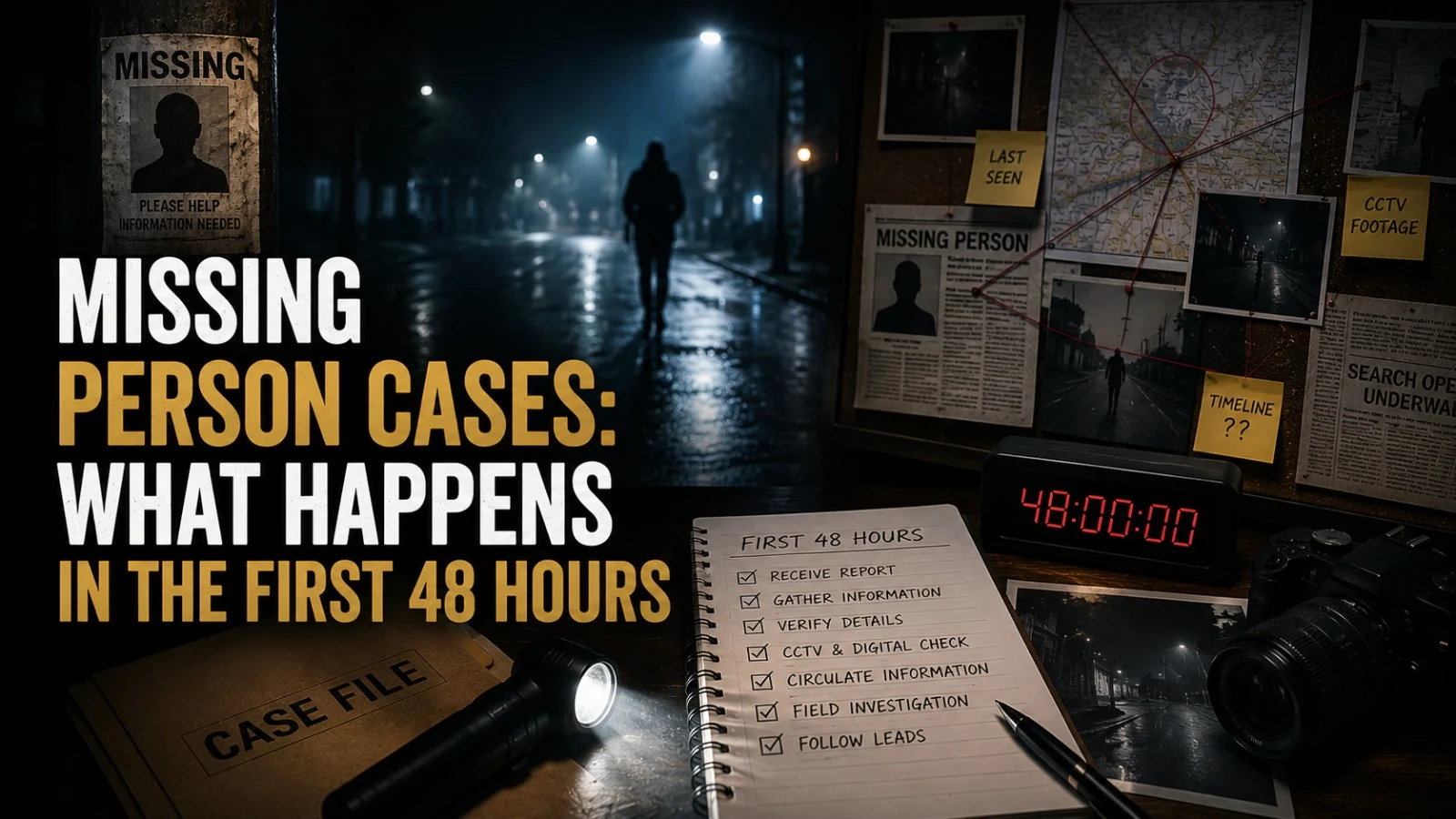
When someone doesn’t come home, the instinct to wait “just a little longer” before doing anything is exactly the instinct that costs the most time. The first 48 hours of a missing person case are the window where CCTV footage still exists, memories are freshest, and leads are easiest to trace. Understanding what to actually do — and dismantling a persistent myth — matters more than almost anything else in these cases.
The Myth That Costs Families the Most Time
The single most damaging misconception is that you must wait 24 or 48 hours before reporting someone missing. This is false. There is no legal waiting period in India. You can and should file a report the moment you have genuine concern about someone’s whereabouts. For a missing minor, or any case involving a vulnerable adult, this should happen immediately, with no hesitation.
Filing the Report: What the Law Actually Requires
Go to the police station with jurisdiction over the area where the person was last seen. If jurisdiction is unclear — the person went missing while travelling, for instance — you can file a Zero FIR at any police station, and it will be transferred to the correct one.
For missing children specifically, the Supreme Court’s directives in Union of India v. Bachpan Bachao Andolan require police to register an FIR immediately and treat the case as a cognizable offence, working on an initial presumption of possible abduction or trafficking until the investigation shows otherwise. For adults, police typically first record it as a missing person report, escalating to an FIR if there’s any suspicion of foul play — but they cannot lawfully refuse to accept and act on the complaint.
The registration of an FIR was historically governed by Section 154 of the CrPC; since 2024, this sits under the equivalent provision of the Bharatiya Nagarik Suraksha Sanhita (BNSS), 2023, which replaced the CrPC.
What to Bring to the Police Station
- A recent, clear photograph
- A physical description — height, build, distinguishing marks, what they were last wearing
- The last known location and time
- The person’s phone number and, if you have it, the IMEI number
- A list of people they were last in contact with
What Happens in a Parallel Private Investigation
Police resources are stretched across many open cases at once, which is precisely why families increasingly run a coordinated private investigation alongside the police process from day one — not instead of it. A structured approach in the first 48 hours typically looks like this:
The first few hours: Initial consultation to gather everything known about the person’s routine, last-seen movements, and digital footprint. Contacting nearby hospitals and casualty wards to rule out a medical emergency, and checking for any “unidentified patient” entries.
Day 1: Collecting CCTV footage quickly, since many private establishments overwrite recordings within 48–72 hours. Canvassing the immediate area — shops, security guards, neighbours — for anyone who saw the person last. Reviewing publicly available digital activity, such as social media posts or app “last seen” indicators.
Day 2: Widening the radius based on Day 1 leads. Extended CCTV review along likely routes. Discreet inquiries at the person’s workplace, college, or regular haunts. Cross-referencing findings with whatever the police investigation has developed so far.
Throughout, evidence gathered — CCTV copies, witness statements, digital leads — is shared with the investigating police officer rather than held separately, since the goal is to accelerate the official investigation, not compete with it.
Not All Missing Person Cases Are the Same
The right approach depends heavily on which category a case falls into:
- Runaways and elopement cases — often involve older teens or young adults who left voluntarily; here, sensitivity matters as much as speed, since police handling can differ from how a family wants a personal situation approached
- Vulnerable adults — elderly people with dementia or others with a cognitive or physical condition tend to be found along familiar routes from their past, which is why early interviews with family about the person’s history and habits matter enormously
- Absconding individuals — someone deliberately avoiding discovery after a financial default or dispute requires a different, more investigative approach than a person who is simply lost
- Suspected foul play — where there’s reason to suspect abduction or harm, coordination with police takes priority, and a private investigation supports that process rather than running independently of it
Digital and Financial Leads Worth Pursuing Early
- Social media activity — public posts, last-active indicators, and mutual connections can offer real leads through open-source research
- Phone activity — actual call detail records and cell tower data can only be obtained through police or a court order, not through a private investigator directly, so this is one area where police involvement is essential from the start
- Financial activity — recent UPI transactions or card usage can sometimes be flagged through the person’s bank, generally requiring the account holder’s family to raise this directly with the bank or through the police
Securing What’s Left Behind
Devices, diaries, and personal items left behind should be preserved untouched rather than opened or “hacked into” by a well-meaning family member — beyond the legal risk of unauthorized access, this can destroy exactly the kind of evidence (message timestamps, location history) that later proves useful.
Frequently Asked Questions
Do I really need to wait 24 hours before filing a police report? No. This is a persistent myth with no legal basis. File as soon as you have genuine concern, especially for children or vulnerable adults.
What’s the difference between a missing person report and an FIR? A missing person report is an initial entry; it’s escalated into a formal FIR when there’s suspicion of a cognizable offence such as abduction, or immediately in the case of a missing child, per Supreme Court directives.
Can a private investigator access someone’s call records or phone location? No — call detail records and tower location data can only be accessed through law enforcement or a court order, which is why coordinating with police from the outset matters even when a family also engages a private investigator.
How long do businesses typically keep CCTV footage? Many private establishments overwrite footage within 48 to 72 hours, which is why requesting copies in the first day or two is one of the most time-sensitive steps in any missing person case.

Rajeev Kumar – CEO, City Intelligence Pvt Ltd
Rajeev Kumar running a leading private detective agency in Delhi with over 24+ years of experience in private and corporate investigations. As a certified member of APDI and WAD, he has successfully solved 4,700+ complex cases across India. His expertise in undercover operations, corporate fraud detection, and advanced surveillance techniques makes him one of the most trusted detective experts in India.
Media Coverage:
Mid-Day Feature
Startup Story Feature
India Saga News
YouTube Interviews:
Exclusive Interview on Investigations
Case Study & Success Stories
Connect with Rajeev Kumar:
LinkedIn
City Intelligence Official Website