A private investigator’s report can be the difference between a strong legal case and a claim that collapses under cross-examination. But not all evidence gathered by a detective is treated equally by a court. Whether it holds up depends less on how compelling the evidence looks, and more on how — and by whom — it was collected.
The Legal Foundation: What Makes Evidence Admissible
Admissibility in Indian courts is governed by the Bharatiya Sakshya Adhiniyam (BSA), 2023, which replaced the Indian Evidence Act, 1872, in 2024. The principles that mattered under the old Evidence Act largely carry forward: evidence must be relevant, authentic, and — critically — lawfully obtained.
This means a court isn’t just asking “does this photograph prove what the client claims?” It’s also asking “was this photograph taken in a way that respected the other party’s legal rights?” Evidence that fails the second test can be excluded even if it clearly supports the first.
What Kind of Investigator Evidence Actually Holds Up
Courts have consistently accepted the following types of evidence from private investigators, provided the collection method itself was lawful:
- Photographs and video taken in public spaces or in locations where there was no reasonable expectation of privacy
- Document verification reports — address checks, employment verification, property records
- Witness statements and affidavits collected during an investigation
- Surveillance logs that record dates, times, locations, and observed behaviour in a factual, non-editorialised way
- The investigator’s own testimony, since a detective can be called and examined as a witness like any other person with relevant knowledge of the facts
The “Legally Obtained” Test Is What Actually Decides the Outcome
This is the single most important factor in whether investigation evidence survives scrutiny. Evidence gathered through phone tapping, hacking into accounts, or trespassing onto private property isn’t just inadmissible — collecting it can expose both the investigator and the client who commissioned it to criminal liability under the Information Technology Act and the Bharatiya Nyaya Sanhita.
In practice, this means a client should be more interested in how an agency plans to gather proof than in how quickly they promise results. An agency that can’t explain its methods in plain, legal terms is a liability, not an asset, once the matter reaches a courtroom.
Electronic Evidence Has Its Own Rules
If the evidence includes anything digital — a recorded video, a screenshot, a data file — it needs to meet the certification requirements that were formerly under Section 65B of the Evidence Act and now sit under the equivalent provision of the BSA. Broadly, this requires a certificate confirming how the electronic record was produced and that it accurately reflects the original, unedited source. Investigators who don’t preserve original files, or who hand over edited or compressed copies without a clear chain of custody, create exactly the kind of gap a defence lawyer will use to challenge the evidence.
What a Court-Ready Investigation Report Actually Looks Like
Reputable agencies build their reports around a few consistent standards:
- Time-stamped, unedited originals of any photo or video evidence, stored alongside metadata
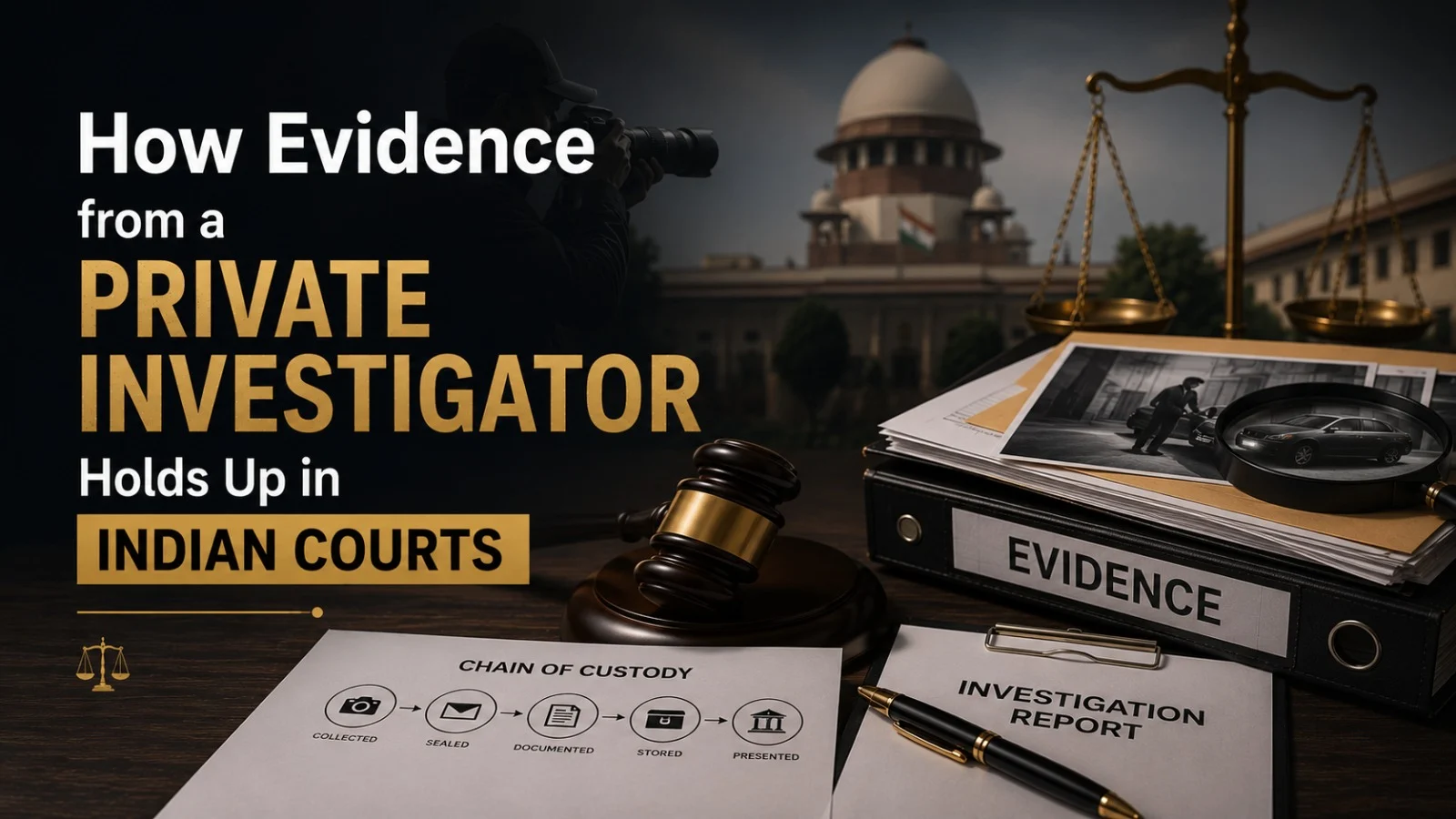
- A documented chain of custody — who collected the evidence, when, and how it was stored and transferred
- Factual, observational language in reports, rather than conclusions or opinions about the subject’s intentions
- Corroborating witness statements, where available, to support what the documentary evidence shows
- A clear methodology section explaining exactly how each piece of evidence was gathered
Investigation evidence rarely wins a case on its own — but built this way, it becomes strong corroborating support alongside documents, witness testimony, and legal argument.
Common Mistakes That Get Investigation Evidence Rejected
- Evidence obtained via phone tapping, hacking, or unauthorised account access
- Video or photographs taken by trespassing onto private property
- Missing or broken chain of custody, so the origin of the evidence can’t be verified
- Edited, cropped, or otherwise altered footage presented without the original source file
- Reports that offer speculation or conclusions rather than documented observations
Frequently Asked Questions
Can a private detective testify in court? Yes. A detective can be examined as a witness, and their findings can be submitted as supporting evidence, provided the underlying methods used to gather that evidence were legal.
Is a private investigator’s report enough to win a case on its own? Usually not by itself. It typically functions as corroborating evidence that supports other documentation, testimony, and legal argument — but a well-documented report can be decisive in tipping the balance.
What happens if evidence was collected illegally? It can be excluded from consideration by the court, and depending on the method used, both the investigator and the client who commissioned the investigation may face separate legal consequences.
Does video evidence need any special certification? Yes. Electronic evidence generally requires a certificate confirming how it was produced and that it hasn’t been altered from the original recording.

Rajeev Kumar – CEO, City Intelligence Pvt Ltd
Rajeev Kumar running a leading private detective agency in Delhi with over 24+ years of experience in private and corporate investigations. As a certified member of APDI and WAD, he has successfully solved 4,700+ complex cases across India. His expertise in undercover operations, corporate fraud detection, and advanced surveillance techniques makes him one of the most trusted detective experts in India.
Media Coverage:
Mid-Day Feature
Startup Story Feature
India Saga News
YouTube Interviews:
Exclusive Interview on Investigations
Case Study & Success Stories
Connect with Rajeev Kumar:
LinkedIn
City Intelligence Official Website